Scale to Grams
How to Weigh Gold at Home and Calculate Its Value
Quick Answer
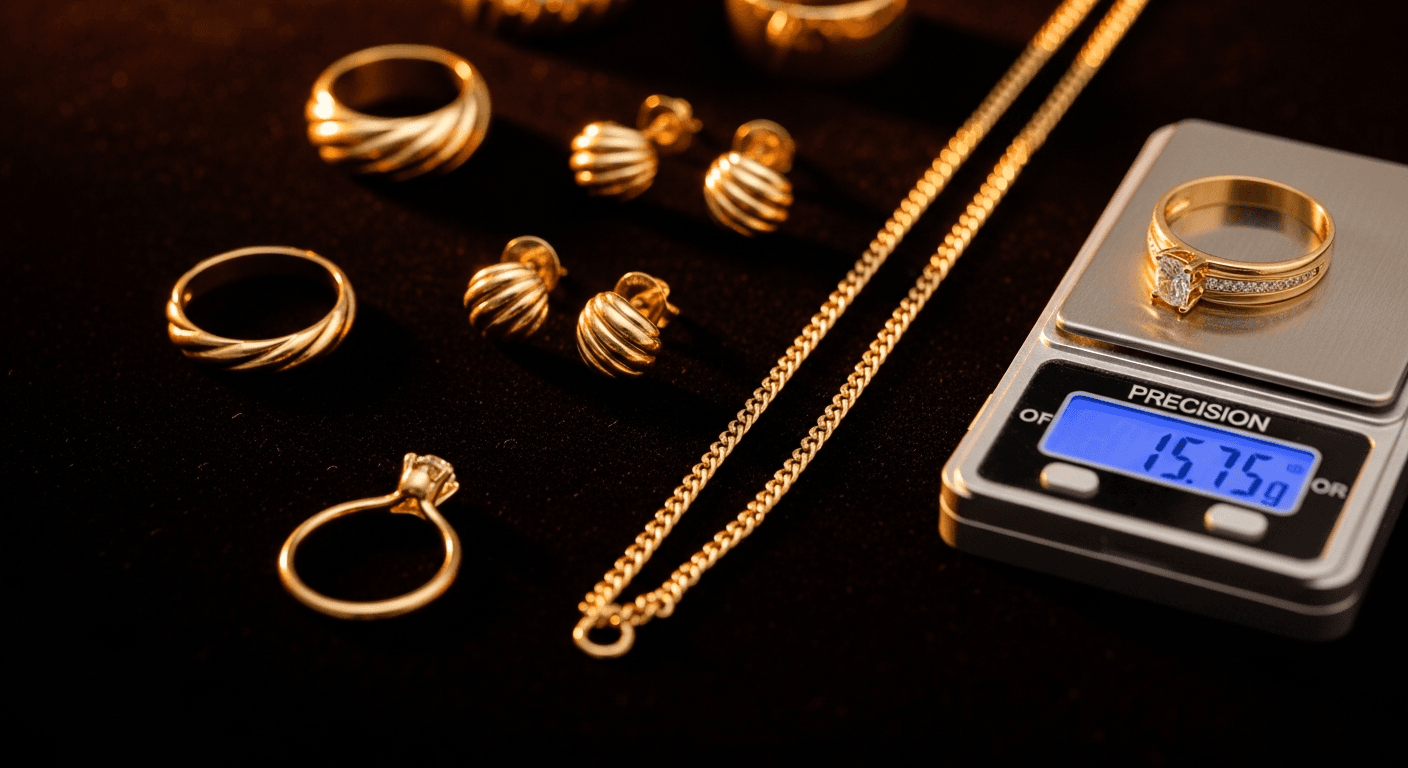
Weigh gold on a digital jewelry scale (0.01g precision, $10-15). Check the karat stamp (10K, 14K, 18K, 24K). Multiply weight in grams x karat purity x current spot price per gram. Jewelry buyers offer 70-90% of this melt value. Walk away from anything under 60%.
Try the Gold Weight Tool14K gold purity
58.3%
most common in US jewelry
24K = pure gold
99.9%
too soft for most jewelry
Troy ounce
31.1g
NOT regular oz (28.35g)
Gold Karat Reference
The karat stamp tells you what fraction of the metal is pure gold. The rest is alloys (silver, copper, palladium) that add hardness.
| Karat | Purity | Stamp | Common use |
|---|---|---|---|
| 24K | 99.9% | 999 or 24K | Bullion, investment |
| 22K | 91.7% | 917 or 22K | Indian, Middle Eastern jewelry |
| 18K | 75.0% | 750 or 18K | Fine jewelry worldwide |
| 14K | 58.3% | 585 or 14K | Most common US jewelry |
| 10K | 41.7% | 417 or 10K | Minimum legal gold in US |
| Gold-plated | <1% | GP, GE, RGP | No scrap value |
How to Weigh Gold at Home
Use a digital jewelry scale with 0.01g precision ($10-15 online). For a no-scale estimate, a US nickel weighs exactly 5g, so balance gold against nickels on a ruler-on-pencil. Photo-based AI weight tools also estimate within ±5%.
Calculate Melt Value
Formula: weight in grams x karat purity decimal x current spot price per gram = melt value. Example: a 14K necklace weighing 15g at $95/g spot = 15 x 0.583 x $95 = $831. Buyers offer 70-90% of this. Below 60% is a lowball.
Troy Ounces vs Regular Ounces
Gold is priced in troy ounces (31.1g), not regular ounces (28.35g). Quoted gold prices "per oz" always mean troy oz. Mixing them up undervalues your gold by ~10%. Always weigh in grams and divide by 31.1 to convert to troy oz.
Gemstones and Plated Items
Gemstones add weight but are not worth the gold price. Estimate and subtract stone weight before calculating. Significant diamonds need a gemologist appraisal. Gold-plated items (stamped GP, GE, RGP) have under 1% gold and almost no scrap value. Real gold is NOT magnetic.
Best Selling Tips
Get quotes from at least 3 buyers. Skip pawn shops (lowest prices). Online buyers (Kitco, APMEX) often pay higher percentages. Sell during price peaks (gold can swing 5-10% per month). Separate by karat in labeled bags so a sneaky buyer cannot price everything at the lowest karat.
Frequently Asked Questions
How much is 1 gram of gold worth?+
In early 2026, the spot price of pure 24K gold is around $95/g. For 14K gold (58.3% pure), 1 gram is worth about $55 in melt value. Check the live spot price before any transaction.
How can I tell what karat my gold is?+
Look for a stamp inside rings, on necklace clasps, or on earring posts. Common stamps: 750 (18K), 585 (14K), 417 (10K). No stamp = take to a jeweler for testing or use a gold acid test kit ($15).
How much will a pawn shop pay for gold?+
Pawn shops typically offer 30-50% of melt value, the lowest of any buyer category. Local jewelers offer 50-75%. Reputable refiners (Kitco, APMEX) offer 80-90%. Always shop multiple buyers.
Can I sell gold-plated jewelry?+
Gold-plated has under 1% gold by weight, so the scrap value is pennies. Sell gold-plated jewelry as costume or designer pieces on eBay or consignment, where the design and brand matter more than gold content.
Is my gold real or fake?+
Quick checks: real gold is not magnetic (use a strong magnet), does not tarnish or rust, and feels heavier than fake gold of the same size. For certainty, use an acid test kit or take to a jeweler.
How do I calculate gold value from grams?+
Weight in grams x karat purity decimal x spot price per gram = melt value. So 10g of 14K gold at $95/g = 10 x 0.583 x $95 = $554 melt value. Buyers offer 70-90% of this.
Try These Tools
Put what you learned into practice with our free AI tools: