Scale to Grams
AI Scale vs Physical Scale: How Accurate Is Photo-Based Weighing?
Quick Answer
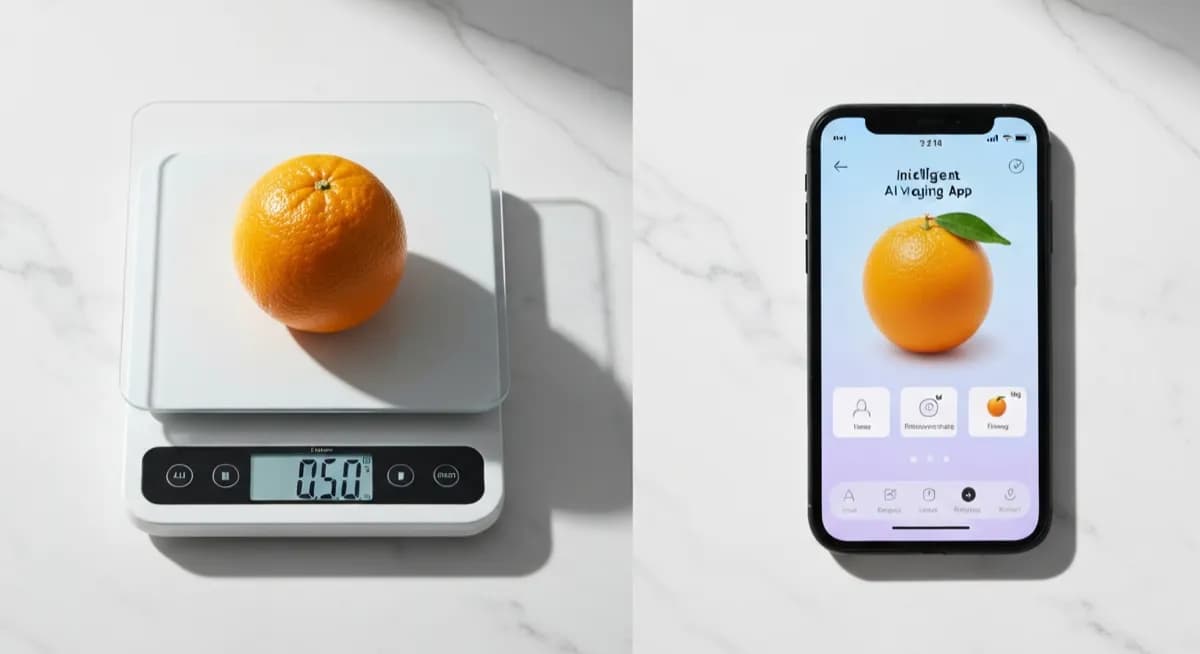
AI photo scales estimate weight within 10-20% of a real digital scale for everyday items. Use them for casual checks and calorie tracking. Use a physical scale for baking, medication, or any commercial use.
Try the AI Digital ScaleAI scale accuracy
~85-90%
within 10-15% of real scale
Digital scale accuracy
99%+
±1g typical
Basic kitchen scale cost
$10-15
breakeven for any baking
How AI Weight Estimation Works
AI scales do not weigh anything. They identify the object, estimate its size against reference points in the photo, and look up the typical weight for that type and size. For a Fuji apple of medium visual size, the AI returns 180-200g. For a sealed Amazon box, it estimates dimensions and infers weight from typical packing density.
Accuracy by Category
AI accuracy depends heavily on what you are weighing. Standardized objects (phones, books, sealed produce) are nearly as good as a physical scale. Custom or irregular items are the worst case.
| Category | AI accuracy | Best tool |
|---|---|---|
| Fruits and vegetables | within 10-15% | AI is fine |
| Cooked plated meals | within 15-20% | AI for tracking |
| Packaged products | within 5-10% | AI excellent |
| Phones, books, electronics | within 2-5% | AI excellent |
| Luggage | within 10-15% | AI for ballpark |
| Small items under 5g | 20-40% | Use gram scale |
| Items over 100 lbs / 45 kg | 15-25% | Use real scale |
| Jewelry, gold, medication | too low | Use precision scale |
When AI Scales Are Good Enough
For checking if your luggage is near the 50 lb (23 kg) airline limit, estimating dinner portions for calorie tracking, ballpark shipping cost estimates, or comparing two objects, AI is faster and free. The 10-20% margin does not matter for these use cases.
When You Need a Physical Scale
Medical dosing, jewelry valuation, commercial sales by weight, exact postage, and pastry baking (where 5g of flour matters) all need a calibrated scale. A basic kitchen scale is $10-15, a postal scale $20-30, a precision 0.01g jewelry scale $15-25.
Improving AI Scale Accuracy
Place the object on a plain contrasting surface. Include a known reference (coin, credit card, dinner plate) in frame. Shoot from directly above with even lighting. A US quarter is 24.26 mm across, a standard dinner plate is 10-11 in (25-28 cm). These calibration points cut error in half.
Frequently Asked Questions
How accurate is an AI scale from a photo?+
AI photo scales are typically within 10-15% of a real digital scale for common foods and products, and within 5% for known electronics like phones and books. Tiny items under 5g or unusual handcrafted items have wider error.
Can my phone weigh things without an app?+
Older iPhones with 3D Touch had a Heft hack that worked roughly, but modern phones cannot weigh physical objects directly. Apps like Scale to Grams use AI vision to estimate weight from a photo instead.
Is an AI scale accurate enough for the gym or weight loss?+
Yes. For tracking food portions and rough calorie counting, the 10-20% accuracy range is fine. For competition prep or precise macro tracking, switch to a physical scale.
Can AI weigh gold or silver?+
No, AI cannot replace a precision jewelry scale for valuing gold or silver. Price per gram matters, and AI error is too high. Use a 0.01g jewelry scale for any real valuation.
Is photo weight estimation legal for selling?+
No. Any commercial transaction sold by weight in the US requires an NTEP-certified Legal-for-Trade scale. AI estimates are not legally valid for sales.
What is the best free AI scale app?+
Scale to Grams offers free AI weight estimation with no signup. Other options include Bite AI for food and CamWeight for general use.
Try These Tools
Put what you learned into practice with our free AI tools: