Scale to Grams
How to Measure Ring Size at Home: 5 Accurate Methods
Quick Answer
Wrap a paper strip snugly around the base of the finger, mark where it overlaps, and measure the length in mm. Divide by 3.14 to get diameter. A 17.3mm diameter is US ring size 7 (54 mm circumference).
Try the Ring Size ToolUS ring size 7
17.3 mm
diameter, ~54 mm circumference
Step per full size
~0.8 mm
in diameter
Best time to measure
End of day
fingers swell with use
US Ring Size Conversion Chart
US ring sizes are based on inside diameter. Here is the conversion to circumference, mm, UK, and EU sizes.
| US size | Diameter | Circumference | UK size | EU size |
|---|---|---|---|---|
| 4 | 14.9 mm | 46.8 mm | H | 47 |
| 5 | 15.7 mm | 49.3 mm | J 1/2 | 49 |
| 6 | 16.5 mm | 51.9 mm | L 1/2 | 52 |
| 7 | 17.3 mm | 54.4 mm | N 1/2 | 54 |
| 8 | 18.1 mm | 57.0 mm | P 1/2 | 57 |
| 9 | 18.9 mm | 59.5 mm | R 1/2 | 60 |
| 10 | 19.8 mm | 62.1 mm | T 1/2 | 62 |
| 11 | 20.6 mm | 64.6 mm | V 1/2 | 65 |
| 12 | 21.4 mm | 67.2 mm | X 1/2 | 68 |
Method 1: Paper Strip
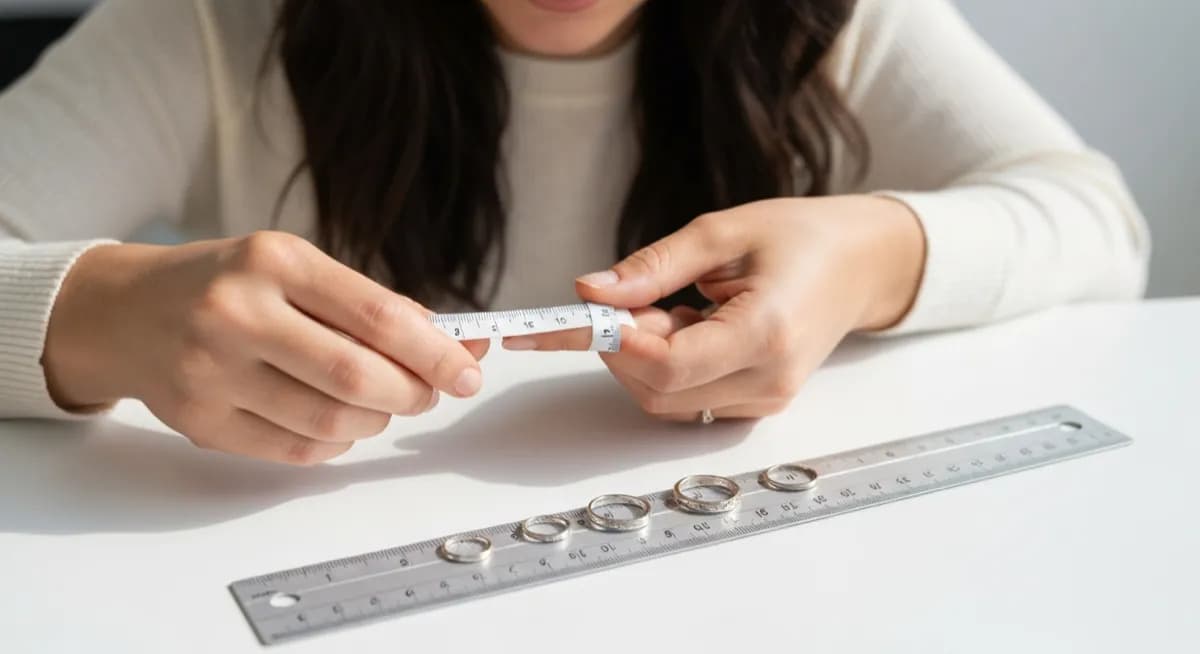
Wrap a thin paper strip snugly around the base of the finger. Mark where it overlaps. Measure the length in mm. That is your circumference. Match to the chart above. Most accurate of the no-tool methods.
Method 2: Measure an Existing Ring
Lay a ring that already fits flat on a ruler. Measure the inside diameter in mm. 17.3 mm = US size 7. This is the most reliable home method, especially for buying a surprise ring (borrow, measure, return).
Method 3: Printable Ring Sizer
Download a free PDF ring sizer from a jewelry site. Print at 100% scale (no "fit to page"). Verify the bar with a ruler. Place your existing ring over the printed circles until one matches.
Method 4: AI Photo Measurement
Photograph your finger or an existing ring next to a coin or credit card for scale. AI tools estimate within half a size. Good enough for casual rings, follow up with a jeweler for engagement rings.
Tips for Accuracy
Measure at end of day when fingers are largest. Measure the exact finger on the exact hand (left and right differ). Avoid measuring after exercise or in cold weather. If your knuckle is much larger than the base, average the two and pick a size in between.
Frequently Asked Questions
How do I find my ring size at home without a sizer?+
Wrap a strip of paper or string snugly around the base of the finger. Mark where it overlaps. Measure the length in mm. Match against a ring size chart (US size 7 = 54 mm circumference / 17.3 mm diameter).
What is the most common ring size for women?+
US sizes 6 and 7 (16.5-17.3 mm diameter) are the most common for adult women. For men, sizes 9-10 (18.9-19.8 mm) are most common.
How can I measure my partner's ring size without them knowing?+
Borrow a ring they currently wear on the correct finger. Trace the inside on paper or measure the inside diameter with a ruler in mm. 17.3 mm = US size 7.
What is the difference between US and UK ring sizes?+
US sizes use numbers (4-13). UK sizes use letters (H-Z). US 7 = UK N 1/2. EU sizes are based on circumference in mm directly (so EU 54 = US 7).
Can my phone measure ring size?+
Yes with AI tools. Photograph your finger or an existing ring next to a credit card (3.37 in / 8.6 cm) for scale, then use an AI ring sizer like Scale to Grams. Accuracy is within half a US size.
When is the best time to measure ring size?+
End of the day, when fingers are at their largest from activity and warmth. Morning measurements can be a full size smaller. Avoid measuring after intense exercise or in cold weather.
Try These Tools
Put what you learned into practice with our free AI tools: