Scale to Grams
How to Measure a Window for Blinds and Curtains

Quick Answer
For inside mount, measure the inside opening at top, middle, and bottom. Use the narrowest width and tallest height. Record to the nearest 1/8 inch and never deduct for clearance (the manufacturer does that). For outside mount, add at least 1.5 in of overlap on each side.
Try the Window Measure ToolMeasure to
1/8 inch
~3 mm precision
Inside mount min depth
1.5 in
3.8 cm for most blinds
Outside mount overlap
1.5+ in
4 cm each side, light blocking
Inside Mount vs Outside Mount
Decide first because measurements differ.
| Mount type | Pros | Cons | Min depth needed |
|---|---|---|---|
| Inside mount | Clean built-in look, no wall coverage | Light gaps possible, needs depth | 1.5-3 in (3.8-7.6 cm) |
| Outside mount | Better light blocking, makes window look bigger | Covers wall space | None |
Inside Mount Measurement Steps
Measure inside opening width at top, middle, and bottom. Use the NARROWEST width. Measure height at left, center, right. Use the TALLEST height. Record to the nearest 1/8 inch. Never deduct for clearance. The manufacturer subtracts 1/4 to 1/2 inch automatically. Also measure frame depth (front to glass).
Outside Mount Measurement Steps
Measure the total area you want covered. Width = window opening + at least 1.5 in (3.8 cm) overlap on each side. Height = window opening + 1.5 in (3.8 cm) above for hardware + 0.5 in (1.3 cm) below or to the sill. For curtains, extend the rod 3-6 in beyond each side and mount 4-6 in above the frame.
Common Mistakes to Avoid
Measuring only at one point (windows are rarely square, top vs bottom can differ 1/4 in). Rounding to the nearest inch (must be 1/8 in precision). Deducting clearance yourself (manufacturer does it). Confusing inside and outside mount on the order form.
Standard Window Sizes for Reference
US standard double-hung windows are 24, 28, 32, or 36 in wide and 36, 48, 54, or 60 in tall. Sliders are 60, 72, or 84 in wide. Picture windows can be 48-96 in wide. Use these as a sanity check on your measurements.
Frequently Asked Questions
How do I measure a window for inside-mount blinds?+
Measure inside opening width at top, middle, and bottom. Use the narrowest width. Measure height at left, center, right. Use the tallest. Record to 1/8 inch and do not deduct anything.
What is the minimum depth for inside-mount blinds?+
Most inside-mount blinds need at least 1.5 inches (3.8 cm) of frame depth. Cellular shades, wood blinds, and Roman shades may need 2-3 inches.
How much wider should outside-mount blinds be than the window?+
Add at least 1.5 inches (3.8 cm) on each side, so 3 inches total. For better light blocking, extend 2-3 inches per side.
How high should I mount curtain rods above the window?+
4-6 inches (10-15 cm) above the frame for a luxurious look that makes the window appear taller. The rod should extend 3-6 inches beyond each side for full visual width.
Should I round window measurements?+
No. Always record to the nearest 1/8 inch. Rounding to the nearest 1/2 or 1 inch causes inside-mount blinds to be too wide and not fit, or too narrow with light gaps.
Can I measure a window with my phone?+
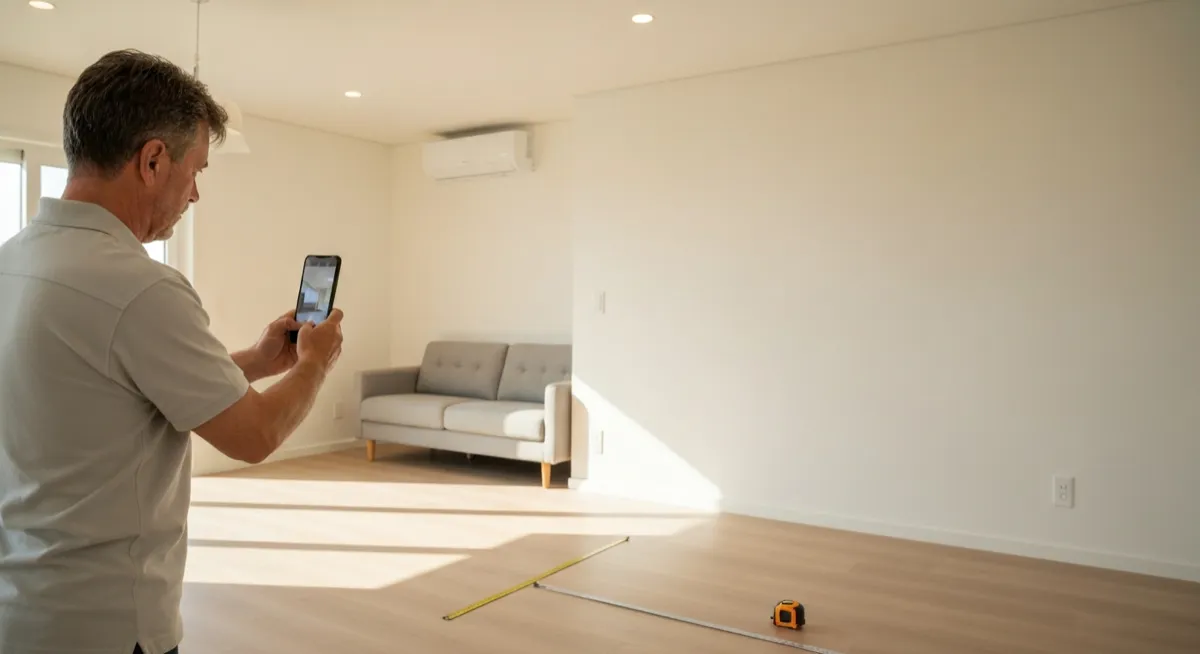
Yes for ballpark estimates. iPhone Measure (LiDAR) and AI tools like Scale to Grams Measure Window estimate within half an inch from a photo. Always confirm with a tape before ordering.
Try These Tools
Put what you learned into practice with our free AI tools: