Scale to Grams
How to Measure Height from a Photo: AI Measurement Guide
Quick Answer
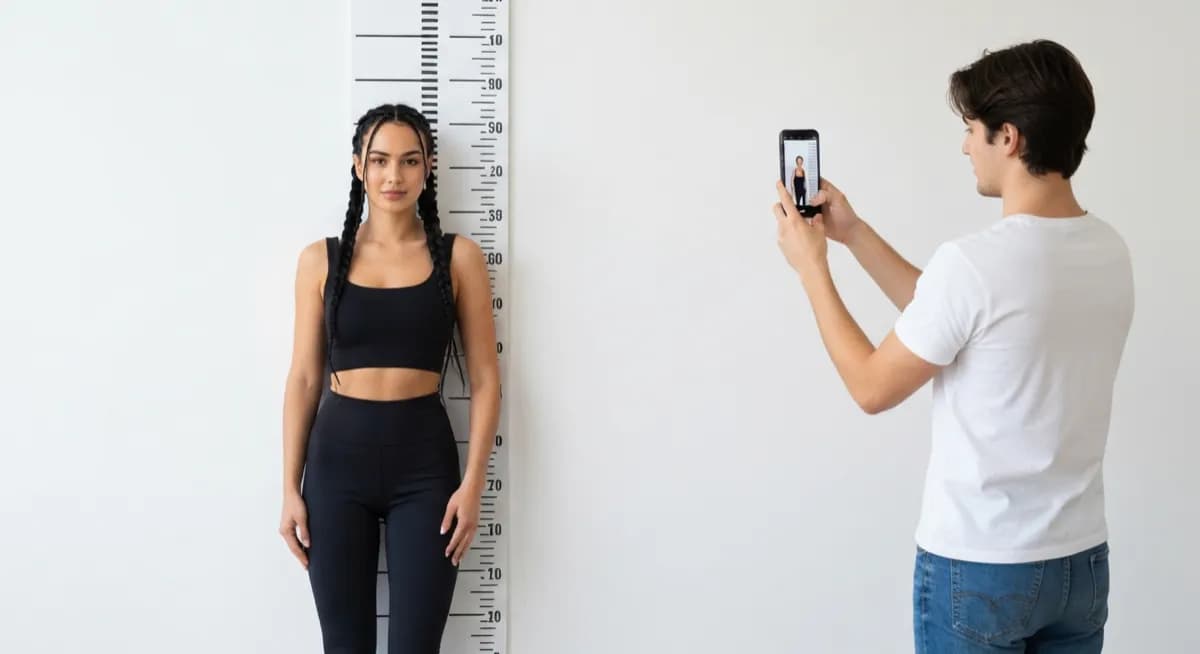
For best AI height estimates, photograph the person full-body from waist height with a standard 80-inch (203 cm) door visible in the frame. Accuracy is within 1-2 inches under ideal conditions, 2-4 inches without a clear reference.
Get unlimited height measurements in the app.

Accuracy (with reference)
±1-2 in
2.5-5 cm
Standard US door height
80 in
203 cm, best reference
US light switch height
48 in
122 cm from floor
Common US Reference Heights
AI height tools work by comparing the person to objects of known size in the frame. Use these standards.
| Reference | Height | Notes |
|---|---|---|
| Interior door | 80 in (203 cm) | Best reference for height |
| Front door | 80 in (203 cm) | Usually 36 in wide |
| Light switch | 48 in (122 cm) | From finished floor |
| Standard outlet | 15-18 in (38-46 cm) | Above floor |
| Kitchen countertop | 36 in (91 cm) | From floor |
| Doorknob | 36 in (91 cm) | Center height |
| US dollar bill | 6.14 in (15.6 cm) | Long edge |
| Credit card | 3.37 in (8.6 cm) | Long edge |
How AI Height Estimation Works
The AI locates the person's head and feet, finds reference objects with known sizes, and uses the pixel ratio plus geometric correction for camera angle and distance to estimate real-world height.
Photo Tips for Accuracy
Camera at waist height, aimed straight ahead, never angled up or down. Person standing straight with feet flat on visible ground. Full body in frame, no cropping. Include a standard interior door behind them as the reference.
Accuracy Expectations
Ideal conditions: ±1-2 in. Without a clear reference: ±2-4 in. Tilted camera: ±3-6 in. Feet not visible: nearly impossible. For medical records or ID, always use a physical tape.
Common Use Cases
Verifying online dating profile heights, casting and modeling portfolios, tracking children's growth, sports recruiting, and surveillance footage analysis.
Measure Yourself Without a Tape
Stand against a wall, balance a flat book on your head pressed against the wall, mark the bottom edge. Then count US dollar bills (6.14 in / 15.6 cm long) from floor to mark. Or photograph next to a doorframe and use an AI tool.
Frequently Asked Questions
How accurate is AI height estimation from a photo?+
With a clear reference object (door, light switch) in frame, AI height tools are accurate within 1-2 inches (2.5-5 cm). Without a reference or with a tilted camera, error grows to 3-6 inches.
Can I tell how tall someone is from their dating profile photo?+
Yes, roughly. If a doorway, car, or other person of known height is visible, an AI height estimator gets within 1-2 inches. Solo selfies with no reference are unreliable.
How tall is the average American man and woman?+
The average US adult man is 5'9" (175 cm). The average US adult woman is 5'4" (162 cm). Use these as soft references when comparing people in group photos.
Can my phone measure height directly?+
iPhone Measure with LiDAR (Pro models) can measure a person's height when they stand still in frame, accurate within 1 inch. Other phones use AI photo estimation with similar accuracy.
What is the best reference object for measuring height in a photo?+
A standard interior door (80 in / 203 cm) is the most reliable. Light switches (48 in / 122 cm), countertops (36 in / 91 cm), and standard credit cards (3.37 in / 8.6 cm) also work.
How can I measure my height at home without a tape?+
Stand against a wall, balance a flat book on your head pressed against the wall, mark with pencil. Then measure with any known object: a standard letter sheet is 11 in (28 cm), a US dollar is 6.14 in (15.6 cm).
Measure Height App
Get unlimited height measurements in the app.
Try These Tools
Put what you learned into practice with our free AI tools: