Scale to Grams
Common Pill Shapes and Colors: ID Guide
Quick Answer
Pill shape and color narrow down possibilities but rarely identify a pill on their own. Many medications share the same shape and color. The imprint code is what makes the identification unique. This guide is for educational reference only — never take a pill you cannot positively identify with a pharmacist.
Identify a Pill From a PhotoFDA-approved pills
15,000+
in the US
Most common shape
Round
~45% of all pills
Colors used
20+ standard
no universal meaning
Important Safety Notice
This is a visual reference guide, not medical advice. Pill shape and color alone are not enough to safely identify a medication. Many different pills look nearly identical. Never take a pill you cannot positively identify with a pharmacist or doctor. If anyone has accidentally ingested an unknown pill, call US Poison Control at 1-800-222-1222 immediately.
Common Pill Shapes
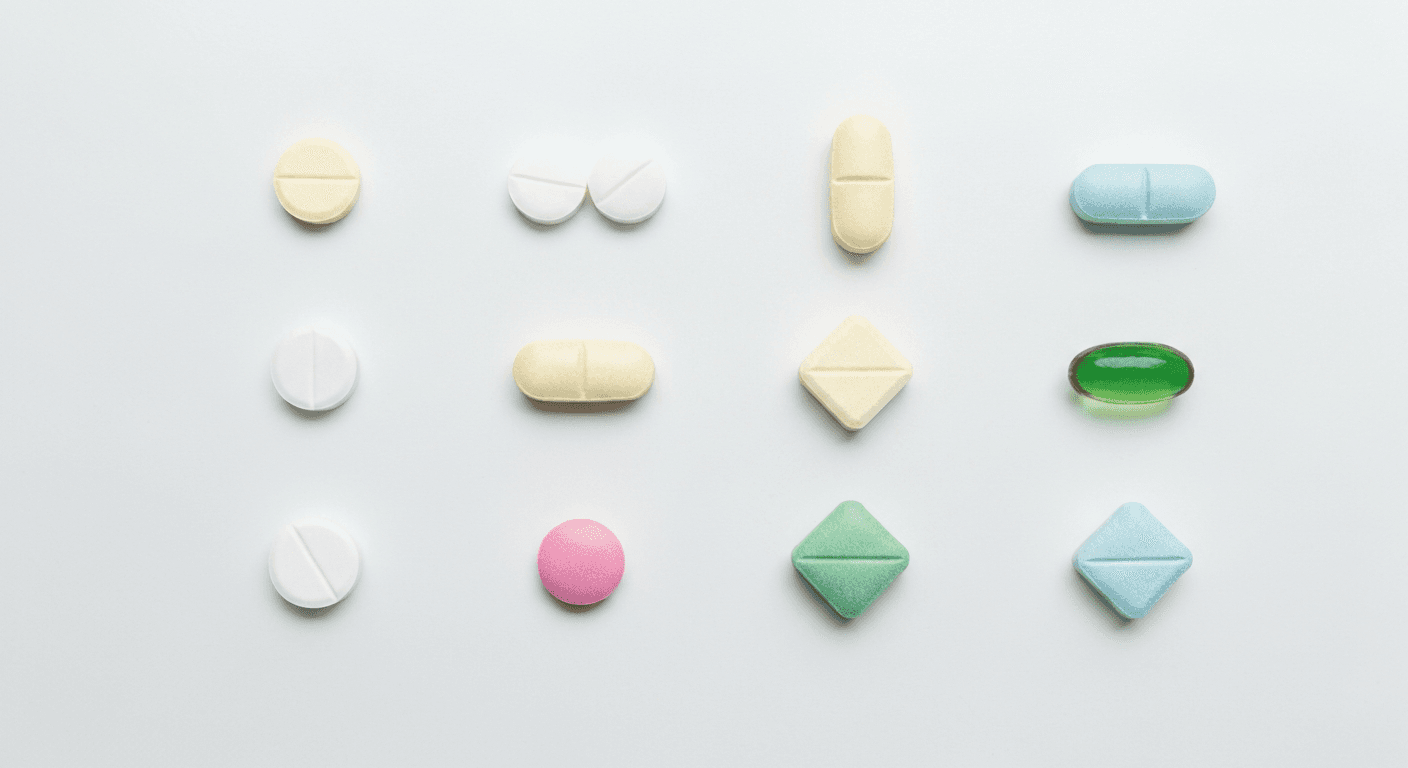
The FDA recognizes a standard set of pill shapes. Here are the most common ones and what they typically indicate (with the caveat that exceptions are everywhere):
| Shape | Common uses | Examples (generic) |
|---|---|---|
| Round | Wide range of medications | Aspirin, ibuprofen, many generics |
| Oval / Capsule-shape | Easier to swallow, often higher dose | Acetaminophen, antibiotics |
| Capsule (two-piece) | Powder or beaded contents | Gabapentin, omeprazole |
| Diamond | Specific brand identifier | Some heart medications |
| Triangle | Rare, often brand-specific | Certain anti-anxiety drugs |
| Pentagon / Hexagon | Brand identifier | Some hormonal medications |
| Square | Less common, often supplements | Various |
| Rectangle / Bar | High-dose tablets, scored | Some psychiatric medications |
What Pill Colors Mean (Or Do Not)
There is no universal coding system for pill colors. Each manufacturer chooses colors for branding and to differentiate doses within their own product line. A red pill from one company means something completely different from a red pill from another company. Some loose patterns:
| Color | Common (not universal) associations |
|---|---|
| White | Generic medications, many OTC drugs |
| Yellow | Many antihistamines, some sedatives |
| Blue | Some sleep aids, some antibiotics |
| Green | Mixed — no strong pattern |
| Pink | Often hormonal or bismuth-based (Pepto) |
| Red / Orange | Often higher-dose markers within a brand |
| Brown | Many older formulations |
| Two-tone | Capsules, often signaling dose strength |
| Clear | Soft gelatin capsules with liquid contents |
Common Shape + Color Combinations
Some shape-color combinations show up frequently. None of these is definitive on its own — always confirm with the imprint:
| Shape + Color | Often (not always) |
|---|---|
| Round, white | Acetaminophen, aspirin, many generics |
| Round, yellow | Diazepam (Valium) generic, some antihistamines |
| Oval, white | Acetaminophen extended release, many antibiotics |
| Oval, blue | Sildenafil (Viagra) generic, some sleep aids |
| Capsule, two-tone | Antibiotics, gabapentin |
| Round, pink | Pepto Bismol, ranitidine generic |
| Round, blue | Some sleep aids, certain heart medications |
Why the Imprint Matters Most
Two pills can be the exact same shape and color but contain completely different active ingredients at completely different doses. The imprint code is the FDA-required unique identifier that solves this. Always start with the imprint when identifying a pill. Use shape and color only as backup or to narrow searches when the imprint is partially worn off. Never trust a visual-only match for medication you might actually consume.
Capsule vs Tablet
Capsules are gelatin shells filled with powder, beads, or liquid. They come in two pieces that snap together. Tablets are compressed, solid pills, sometimes coated. Both can be in any color. Capsules cannot usually be split (the contents would spill), while tablets often have a score line indicating they can be split for dose adjustment. The shape gives you a clue about how the medication is delivered (extended release, immediate release, etc.).
How to Use AI for Visual Pill ID
Place the pill on a plain white surface under bright natural light. Photograph both sides clearly, with imprints visible. Include a coin or another scale reference if possible. Upload to our AI Pill Identifier. The AI matches shape, color, and visible imprint against a database. Treat the result as a starting point — confirm with a pharmacist before taking any pill identified this way. The AI is best at narrowing possibilities, not at making final decisions about medication.
Frequently Asked Questions
Can I identify a pill by shape and color alone?+
You can narrow the possibilities significantly, but you cannot make a definitive ID. Many different medications share the same shape and color. The imprint code is what makes the identification unique. Always confirm with a pharmacist before taking any unknown pill.
Do colors mean anything specific for pills?+
No — there is no universal color coding for medications. Each manufacturer chooses colors for branding. A blue pill from one manufacturer is different from a blue pill from another. Patterns exist within a single product line (different doses get different colors) but not across the industry.
What is the most common pill shape?+
Round, accounting for about 45% of all pills on the US market. Oval and capsule shapes follow. Less common shapes (diamond, triangle, pentagon) are often used as brand identifiers for specific medications.
Why are some pills two different colors?+
Two-tone pills are usually capsules, with each half a different color. The color combination is part of the manufacturer's branding and often signals the dose strength within the product line. The imprint code on each half tells you exactly which medication and dose.
What does a scored line on a pill mean?+
A scored line (a single or double indented line across the pill) means the manufacturer designed the pill to be split, usually for dose adjustment. Pills without a scored line should generally not be split — they may have an extended-release coating that breaks down if cut.
Can I trust an AI pill identifier?+
Use it as a first-pass screening only. AI tools can identify obvious pills with high confidence, but they can also misidentify look-alikes. For any pill you might take or give to someone, always confirm with a pharmacist. The cost of a wrong identification is too high for an AI to be the final word.
What should I do if I find a pill I cannot identify?+
Do not take it and do not let anyone else take it. Photograph it, search the imprint on NLM Pillbox or Drugs.com, and bring it to a pharmacist if still unidentified. If a child or pet swallowed it, call US Poison Control at 1-800-222-1222 immediately.
Try These Tools
Put what you learned into practice with our free AI tools: