Scale to Grams
How to Spot Fake Nike Sneakers (Step-by-Step Guide)
Quick Answer
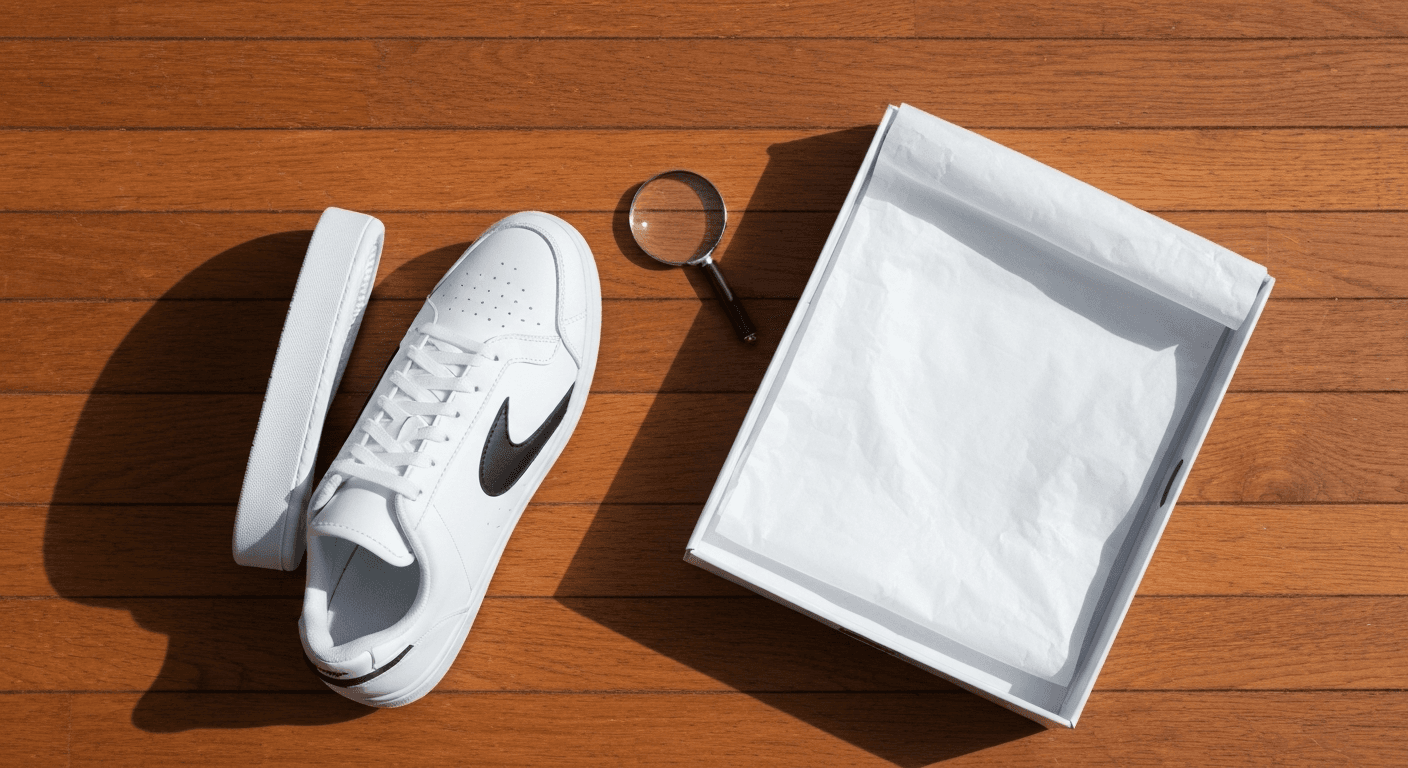
Check the box label first (font, SKU format, sticker quality), then inspect stitching for symmetry, then check the tongue label font and the smell of the glue. Most fakes fail at least one of these. Snap a photo and use our AI Sneaker Identifier as a second opinion.
Authenticate Your SneakersFakes in resale market
~25%
industry estimate
Easiest red flag
Box label
check first
Inspections to do
10 steps
covers ~95%
The 10 Things to Check
A real authentication is a process, not a single test. Here is the order experts work through, from fastest to most involved:
| # | What to check | What to look for |
|---|---|---|
| 1 | Box label | Crisp font, correct SKU format, no smudges |
| 2 | Box quality | Sturdy cardboard, exact color match |
| 3 | Tongue label | Font weight, spacing, stitching |
| 4 | Stitching overall | Even, straight, no loose threads |
| 5 | Sole pattern | Sharp lines, correct depth |
| 6 | Glue lines | Clean, no excess |
| 7 | Smell | Leather/rubber, not chemical/plastic |
| 8 | Insole print | Crisp Nike branding, correct size code |
| 9 | Logo placement | Symmetric on both shoes |
| 10 | Weight & feel | Solid, not flimsy or too light |
Box Label: The Fastest Check
The Nike box label is one of the most counterfeited and most consistent things to check. Real labels have specific formatting:
| Element | Real | Fake (common) |
|---|---|---|
| Font | Crisp Helvetica-style, evenly spaced | Slightly off, sometimes blurry |
| SKU/Style number | 6 digits + dash + 3 digits (e.g., 315122-001) | Wrong digit count or format |
| UPC barcode | Sharp, scannable, matches SKU | Blurry or scans wrong |
| Made in country | Indonesia, Vietnam, China, Thailand | Vague or unusual country |
| Sticker adherence | Flush with box, no bubbles | Lifting edges, bubbles |
| "NIKE" logo on label | Even letter spacing | Compressed or stretched |
The Tongue Label Test
The tongue label often gives fakes away because counterfeiters have to recreate small text with thread. Things to inspect: font weight should match other Nike products you own (search the same model on Nike.com for reference). Letter spacing should be even — "NIKE AIR" especially. Stitching around the label should be tight and parallel. The size tab below the main label should have crisp print, not blurry. Compare both shoes — fakes often have slight differences left vs right that real Nikes do not.
The Stitching Test
Real Nike production has tight quality control on stitching. Fakes often show: loose threads (more than 2-3 visible per shoe), uneven spacing between stitches, stitches that wander off the seam line, double stitching where there should be single, and visible glue or excess fabric at stitch endpoints. Run your finger over every seam — anything rough or uneven is a red flag.
The Smell Test
Real Nikes smell like leather and rubber. Cheap fakes smell strongly of plastic, solvent, or chemical glue. The smell sometimes does not show through new shoes for a day or two of wear, when sweat activates it. If a "new" shoe smells aggressively chemical out of the box, it is suspect. Note that some legit factory-direct shoes also smell rubbery for the first few days, so smell alone is not definitive.
When in Doubt: Photo + AI
If your manual checks are inconclusive, photograph the shoes (top, side, bottom, tongue label, box label) under good lighting and run them through our AI Sneaker Identifier. It cross-references against a database of known authentic and counterfeit examples and returns a confidence score. Use it as a second opinion, not as a sole verdict on a $300+ purchase.
Where to Buy to Avoid Fakes
The safest sources for new Nike sneakers are: Nike.com directly, Nike retail stores, Foot Locker, Champs Sports, Finish Line, Dick's Sporting Goods, and authorized department stores (Macy's, Nordstrom). Resale platforms with authentication: GOAT, StockX, Stadium Goods. Marketplaces with high counterfeit rates: random eBay sellers, Facebook Marketplace, Mercari, and any seller offering current models 30%+ below retail.
Frequently Asked Questions
How can I tell if my Nikes are fake?+
Check the box label first (font and SKU format), then the tongue label stitching, then the smell. Real Nikes have crisp printing, tight even stitching, and smell like leather/rubber rather than chemicals. Most fakes fail at least one of these tests.
Are fake Nikes illegal to sell or own?+
Selling counterfeits is illegal under US trademark law. Owning them is not illegal but can cause customs issues at international borders. Knowingly selling fakes can result in fines and seizure.
Can fake Nikes be high quality?+
Some "super fakes" (or UA, "unauthorized authentic") are extremely close to real and require expert authentication to spot. They often come from the same factories during off-hours. They are still counterfeit and not Nike-warrantied.
Where can I get sneakers authenticated?+
Resale platforms like GOAT, StockX, and Stadium Goods authenticate every pair before shipping. Independent services like Legit Check App charge $5-15. Our AI Sneaker Identifier provides a free first-pass screening from a photo.
How much do real Nike sneakers cost?+
Current Nike retail ranges from $80 (Air Force 1) to $230 (LeBron, KD, Kobe). Limited drops and Jordan collaborations resell from $200 to $5,000+. If a current-model Nike is offered new at 40-60% below retail, it is almost certainly fake.
What is the easiest fake to spot?+
Air Jordan 1s in obviously wrong color schemes (e.g., colorways Nike never released) and Air Force 1s with off-spec swooshes are the most obvious. Counterfeiters often invent custom colorways since they do not need to match Nike's actual catalog.
Do real Nikes always have a code on the inside?+
Yes. Real Nikes have a manufacturing code printed inside the shoe on the size tag, including the SKU, size, and country. The code should match the box label exactly. Fakes often have mismatched codes or printing that looks blurry.
Try These Tools
Put what you learned into practice with our free AI tools: