Scale to Grams
How Much Does a Slice of Pizza Weigh? Calories by Size & Type
Quick Answer
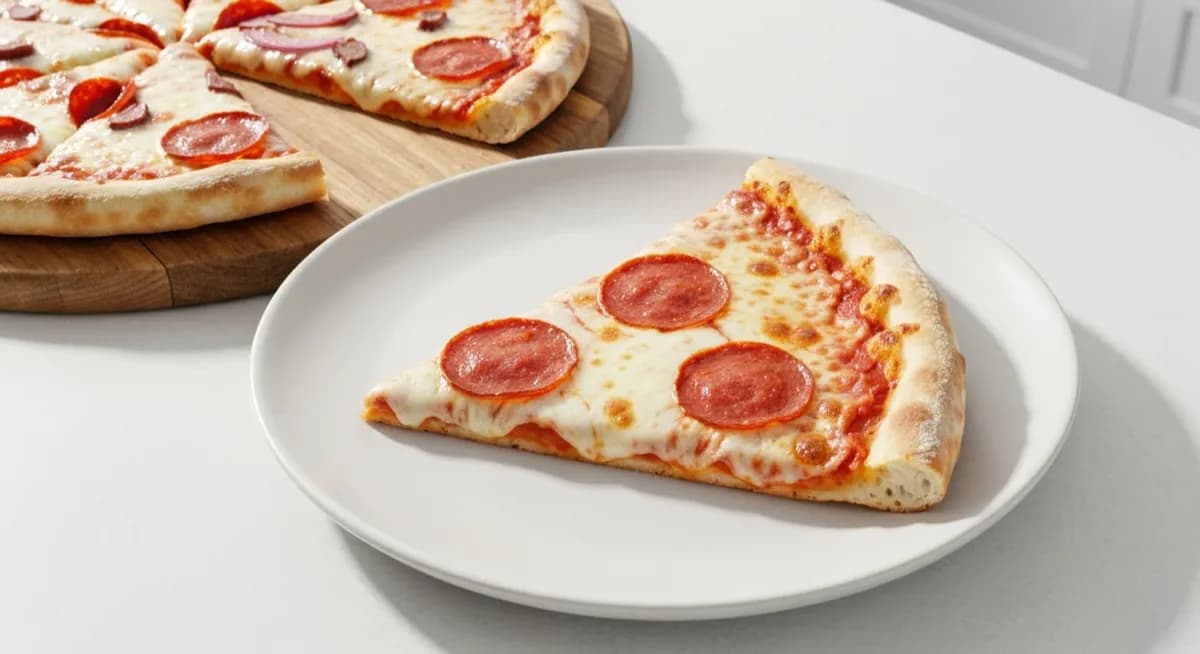
A standard cheese slice from a 14-inch large pizza weighs about 3.8 oz (107g) and has 285 calories. New York 18-inch slices weigh more (4.6-6.3 oz / 130-180g, 300-350 cal), and Chicago deep dish slices weigh up to 10 oz (280g+) at 450 calories or more.
Weigh Food From a PhotoStandard slice
3.8 oz
107g, 14-in pizza, 1/8
NY slice
4.6-6.3 oz
130-180g, 18-in pizza
Calories (cheese)
~285 cal
standard slice
Pizza Slice Weight by Style
Style and diameter are the two biggest variables. A pizza cut into 8 slices means a slice weight that scales with total size.
| Style | Pizza size | Slice weight | Calories |
|---|---|---|---|
| Cheese (chain large) | 14 in / 1/8 | 3.8 oz / 107g | ~285 cal |
| Thin crust | 12 in / 1/8 | 2.5-3 oz / 70-85g | 190-220 cal |
| New York | 18 in / 1/8 | 4.6-6.3 oz / 130-180g | 300-350 cal |
| Chicago deep dish | 12 in / 1/8 | 7-10 oz / 200-280g | 350-450 cal |
| Detroit square | 8x10 in / 1/8 | 5-6 oz / 140-170g | 320-400 cal |
| Personal pan | 6 in / 1/4 | 2.5-3 oz / 70-80g | 180-220 cal |
| Frozen (DiGiorno) | 12 in / 1/6 | 3-4 oz / 85-110g | 270-320 cal |
How Toppings Change Weight
Toppings add real weight. Pepperoni adds 10-15g per slice (~50 cal). Sausage adds 15-25g (~70 cal). Veggies add 10-20g (~25 cal). Extra cheese adds 20-30g (~80 cal). A meat lover's slice can weigh nearly double a plain cheese slice and hit 400+ calories.
Why Pizza Sizes Are Confusing
A "large" at Domino's, Pizza Hut, and Papa John's is 14 inches. But a New York pizzeria large is 18 inches. Costco pizza is 18 inches. Pizza area scales with the square of the diameter, so an 18-inch pizza is 65% bigger than a 14-inch pizza, not 29%. Slice weight scales the same way.
Estimate Slice Weight Without a Scale
A standard 14-inch slice is roughly the size of two adult hands side by side (~107g). Thin crust = 70% of standard. Deep dish = roughly 2x. For an instant estimate, photograph the slice with our AI scale tool.
Quick Calorie Math
For chain pizza, multiply slice weight in grams by 2.6 cal/g for cheese, 2.9 cal/g for pepperoni, 3.1 cal/g for meat lover's. So a 150g pepperoni slice = ~435 cal.
Frequently Asked Questions
How many calories in a slice of pizza?+
A standard cheese slice from a 14-inch large pizza has about 285 calories. Pepperoni is 320-360, meat lover's is 350-400, and Chicago deep dish runs 350-450 per slice.
How many calories in a slice of Domino's pizza?+
A slice of Domino's 14-inch hand-tossed cheese is about 200 calories. Pepperoni is 220, ExtravaganZZa is 280. Brooklyn-style and thin crust are about 30-40 cal less per slice.
How much does a slice of Costco pizza weigh?+
A slice of Costco 18-inch pizza weighs about 11-13 oz (310-370g) and has 700-800 calories. It is roughly double a standard chain slice in both weight and calories.
How many slices in a large pizza?+
A standard US large pizza (14 inches) is cut into 8 slices. Some pizzerias cut into 10. New York 18-inch pizzas are also typically 8 slices, just much bigger ones.
How much does a whole 14-inch pizza weigh?+
A 14-inch cheese pizza weighs about 30 oz (850g) total. With pepperoni it climbs to 32-34 oz. A loaded meat lover's 14-inch can hit 40 oz (1.1 kg).
How much does a slice of frozen pizza weigh?+
A slice of frozen pizza (1/6 of a 12-inch DiGiorno-style) weighs 3-4 oz (85-110g) and has 270-320 calories. Per-slice nutrition is on the box.
Try These Tools
Put what you learned into practice with our free AI tools: